Open call · no closing date
That phone sitting in your drawer can become a scientific instrument.
We take used smartphones and turn them into open-source measuring equipment: stations that listen to birds in the field, open hardware for audio capture, and computing nodes built from devices that were headed for the bin.
- Drop-off in person in Bogotá
- We arrange with you how to get it to us
01 · What we take
Three conditions. Nothing else.
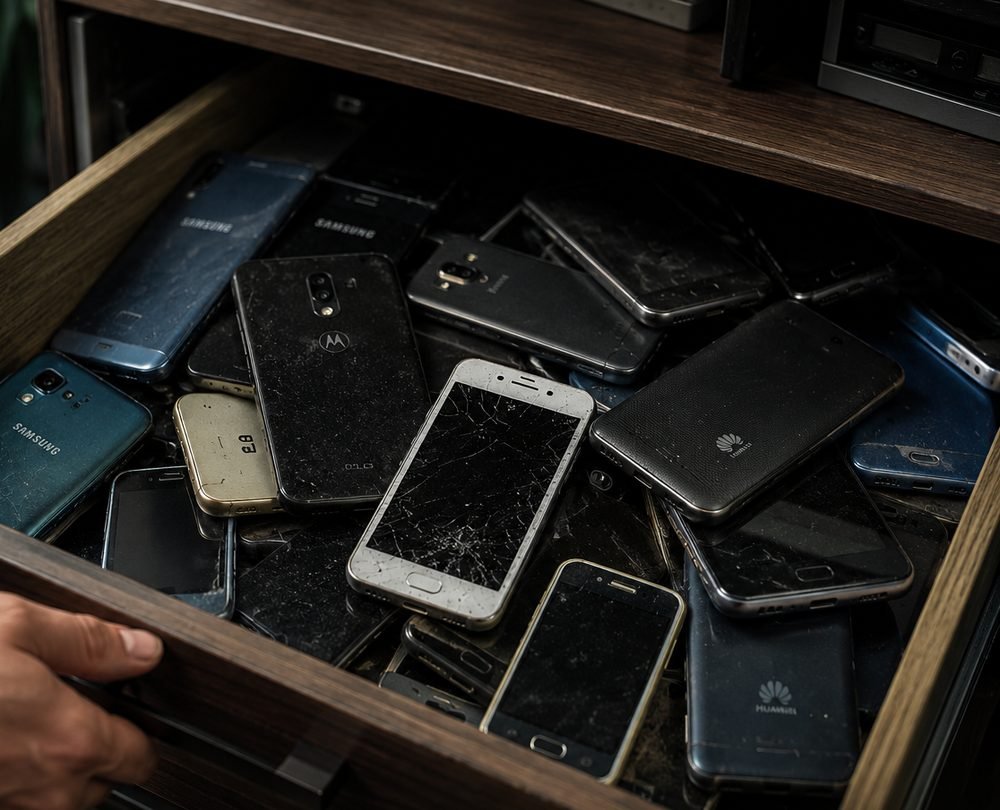
We are not after a particular model or a good-looking phone. If it powers on, charges and connects to Wi-Fi, we can use it.
-
Any brand
Samsung, Xiaomi, Motorola, Huawei, iPhone — whichever. Model and age do not matter.
-
Working
It has to power on and charge. Scratches, a cracked case or a battery that no longer holds: none of that matters.
-
Wi-Fi capable
It has to connect to a Wi-Fi network. That is the only thing we use to set it up and update it.
No line, data plan or SIM needed. We do not ask for the charger or the box either.
02 · Where they go
Three projects, three stages of maturity.
We would rather say where each thing actually stands than promise too much. Everything we publish is open source.

appAves — a bioacoustic station inside a phone
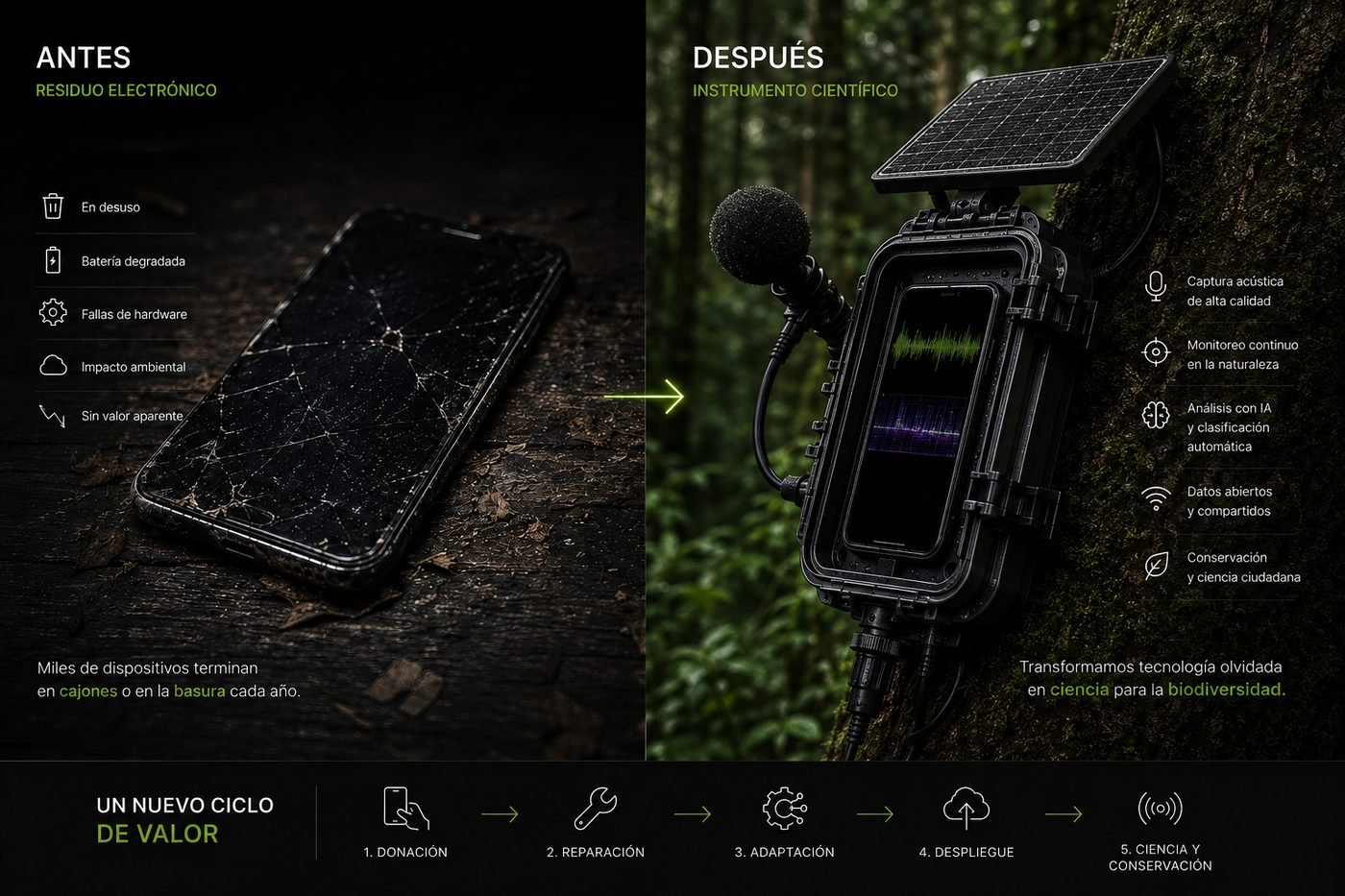
A donated Android phone becomes an autonomous wildlife monitoring station in the field: it identifies species by their song with a model that runs on the device itself, sending nothing to the cloud. It pairs with the open audio capture hardware designed by the same team.
In development · AGPL-3.0
See the project page →
Bioacoustics — open microphone front-end
The audio hardware that connects to the donated phone: a board with a capsule microphone, a preamplifier and USB output, to capture field sound at a quality good enough to identify species. Open circuit design in KiCad and SPICE.
Reference design (verified by simulation) · AGPL-3.0
See the project page →
OpenRackPhone — computing with disused phones
Devices that are not fit for field work feed the distributed computing testbed: disused phones as nodes of a low-cost cluster. This is ongoing research, not something that already works.
Under research
See the project page →
03 · How to donate
Four steps, and it costs you nothing.
The whole process, from your drawer to the field. Write to us and we handle the rest.
- 1
Factory-reset the phone
Before handing it over, reset it to factory settings and sign out of your Google or Apple account. That protects your privacy and means we never handle your data. If you are not sure how, write to us and we will walk you through it.
- 2
Write to us
An email or a message to our phones. Tell us which city you are writing from and how many devices you have.
- 3
We arrange the handover
If you are in Bogotá, you can drop it off in person at our office. If you are in another city, write to us and we will work out the best way to get it to us.
- 4
Your phone becomes an instrument
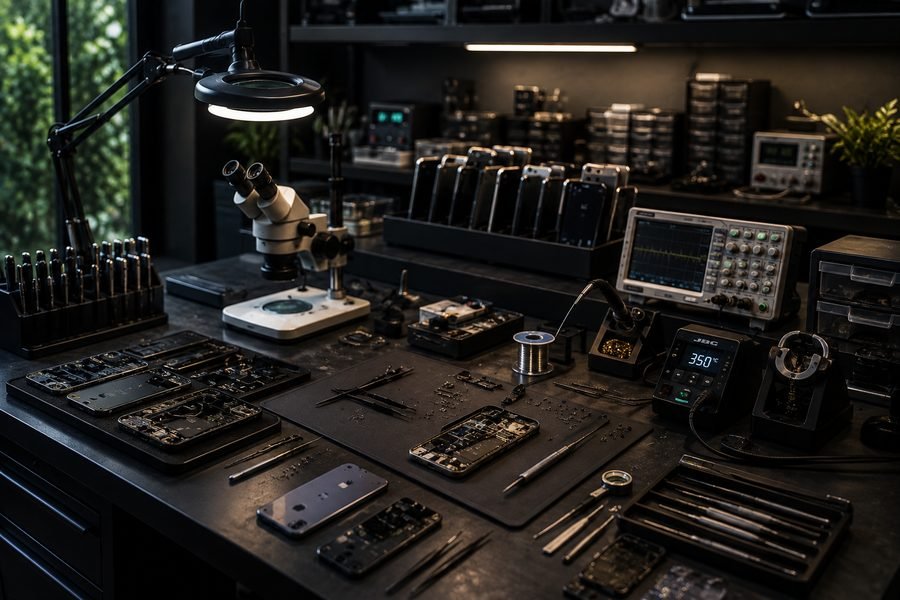
We confirm by email that it arrived. It joins the preparation queue and ends up mounted in a monitoring station, connected to an audio capture board, or in the distributed computing testbed.
04 · Logistics
Getting it to us.
Write to us and we will arrange whichever way suits you best.
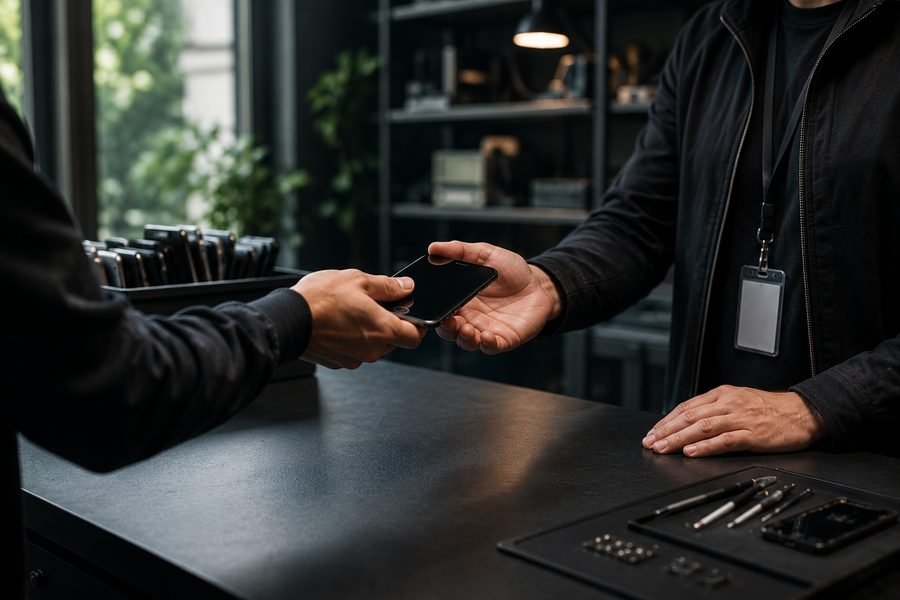
Drop-off in person in Bogotá
Cl 64 No. 11-37 Of. 308, Bogotá D.C., ColombiaWrite to us first so we can agree on a day and time.
Before you hand it over
Factory-reset the phone and remove your Google or Apple account. A device with the account still active stays locked and we cannot use it.
05 · Electronic waste
A reused phone is a phone that does not get thrown away.
A great deal of electronic equipment is discarded in Colombia and very little of it enters a formal recycling chain. A phone that still powers on has a working processor, memory, sensors and radio: extending its life as a measuring instrument is cheaper and less polluting than manufacturing a new one.
We do not promise to solve the electronic waste problem. What we can do is give every device we receive a concrete use, and tell you what it ended up as.
06 · Questions
What people ask us most.
Do you take tablets?
Yes, on the same condition: it must power on, charge and connect to Wi-Fi. Any brand.
Do I need to include the charger?
It is not required. If you have one you are not going to use, we can put it to work; if not, just hand over the phone.
Will you confirm the device arrived?
Yes. We email you once we have received it.
Is a cracked screen or a worn battery a problem?
No. Cosmetic condition does not count, and neither does the battery: in the field the devices run on external power. What we do need is that it powers on and has Wi-Fi.
How long is the call open?
It is permanently open, with no closing date. You can write to us at any time.
What if the phone is no use for any of the projects?
We take it to an electronic waste handler rather than returning it or letting it pile up. We let you know if that is the case.
07 · Contact
Got a phone sitting in a drawer? Write to us.
Open call, no closing date. One email is enough to get started; we will arrange the handover with you.
- contactenos@excribe.co
- Phones
- Address
- Cl 64 No. 11-37 Of. 308, Bogotá D.C., Colombia
- The projects
- Lab →